
Trading the Asian Forex Session from Nigeria
🌏 Explore the Asian forex trading session's timing, trends, and tips tailored for Nigerian traders to boost profits when Asian markets are live.📈
Edited By
Isabella Hughes
Forex trading thrives on global market hours, but these hours don’t line up neatly with Nigerian local time. For traders in Lagos, Abuja, or Port Harcourt, understanding when each forex session opens and closes is key to seizing the best trading opportunities and managing risk effectively.
The forex market operates 24 hours a day, divided into four major sessions: Sydney, Tokyo, London, and New York. Each session reflects the working hours of major financial centres across the world. Nigerian traders operate mostly within West Africa Time (WAT), which is UTC+1, and this time difference means that activity in foreign markets impacts trading windows locally.
Knowing when to trade means knowing when the market is most active and when it tends to be quiet. High activity often brings better liquidity and tighter spreads, which can translate to more profitable trades. Conversely, low activity times may lead to slower price movements and wider spreads, raising trading costs.
Below are the rough local times in Nigeria for the key forex sessions:
Sydney: 9:00 pm to 6:00 am WAT
Tokyo: 12:00 am to 9:00 am WAT
London: 8:00 am to 5:00 pm WAT
New York: 1:00 pm to 10:00 pm WAT
These sessions overlap at various points, and overlapping periods usually see heightened trading volume. For example, the London-New York overlap (1:00 pm to 5:00 pm WAT) is often when the market is most lively and volatile, giving Nigerian traders more chances to enter and exit positions efficiently.
Understanding these session times also helps traders anticipate economic news releases, usually scheduled during active market hours. For instance, Bank of England or European Central Bank announcements often occur during London session hours, while US economic data drops during the New York session.
For Nigerian traders, matching trading hours to personal schedules and market volatility is crucial. Trading during the most active sessions or overlaps can increase potential profits, but requires strong risk management to handle rapid price swings.
This knowledge becomes even more important when factoring in local conditions such as power supply interruptions and network stability. By planning trades around peak forex session hours and preparing for infrastructural challenges, Nigerian traders can position themselves better for consistent success in the forex market.
Understanding forex trading sessions is essential for anyone serious about trading currencies from Nigeria. These sessions define the active hours when buyers and sellers are most engaged, directly affecting liquidity, volatility, and price movements. For Nigerian traders, knowing these schedules helps avoid low-activity periods when spreads widen and execution slows.
Forex trading sessions represent the different time blocks during which major financial centres in the world operate. Essentially, the market is open 24 hours because as one financial hub closes, another opens. Each session has unique characteristics shaped by regional economic activity, local business hours, and market participants.
Globally, the forex market operates across four main sessions: Sydney (Asia-Pacific), Tokyo (Asia), London (Europe), and New York (North America). These sessions reflect when traders in these regions are most active. For example, the Tokyo session is dominant from roughly 12:00 am to 9:00 am WAT (West Africa Time). Each session opens and closes according to its local time, but Nigerian traders must convert these hours to WAT to align their strategies properly.
Sessions sometimes overlap, which means two major markets are open simultaneously. This overlap often results in higher liquidity and increased market activity. Notably, the London–New York overlap, from 1:00 pm to 5:00 pm WAT, sees some of the day's heaviest trading volumes and most significant price movements.
The timing of forex sessions impacts currency volatility, which is a key driver of trading opportunities. During active sessions, price fluctuations are more pronounced, offering chances for profit. Conversely, during quieter hours, the market tends to be flat or exhibits erratic movements, which can trap unwary traders.
Liquidity also varies across sessions. Higher liquidity during session overlaps means tighter spreads and faster trade execution, reducing transaction costs. For Nigerian traders using platforms like Kuda or GTBank for forex trading, this means better pricing and less slippage when trading major pairs like USD/NGN or EUR/USD.
These factors shape trading strategies. For instance, some traders focus on volatile periods to scalp quick profits, while others prefer stable phases for swing trading. Understanding session nuances allows traders to schedule their activities around predictable market behaviour, improving consistency and risk management.
Knowing when forex sessions start and end in Nigerian time isn't just about convenience—it affects your bottom line directly by aligning trades with market rhythms.
Nigerian traders should also consider local factors such as economic data releases by the Central Bank of Nigeria (CBN), which can add another layer of volatility during specific sessions. Combining session knowledge with these events can offer a strategic edge.
By mastering forex session times, Nigerian traders can avoid pitfalls like trading during low liquidity hours, reduce costs, and seize moments when the market is most lively and profitable.
Understanding the timing and characteristics of the major forex sessions helps Nigerian traders maximise their strategies. Each session carries unique traits affecting market activity, liquidity, and volatility. Knowing when these sessions start and end in West Africa Time (WAT) is crucial for managing trades effectively and taking advantage of market moves.
The Asian session generally runs from 12:00 am to 9:00 am WAT, starting with the Tokyo market open and extending to include Sydney and Hong Kong. For Nigerian traders, this timing means the forex market is active late at night to early morning hours. While this could be inconvenient for some, active traders or those using automation can benefit from market trends set during this time.
Key currency pairs in this session include those linked to the Japanese yen (JPY), the Australian dollar (AUD), and the New Zealand dollar (NZD). For example, USD/JPY and AUD/USD see more activity in these hours. Nigerian traders focusing on these pairs could find better volatility and tighter spreads in the Asian session.
Market behaviour during the Asian session tends to be quieter compared to European or North American sessions. Price moves are usually more subtle with lower volatility. This session often sets the groundwork for trends that intensify once Europe and North America open. Nigerian traders might use this time for positioning and analysis rather than aggressive trading.
The European session starts around 8:00 am WAT and closes about 5:00 pm WAT, making it highly relevant to Nigerian traders as it overlaps with regular working hours. This timing enables easier monitoring without staying up late or waking early.
Major currency pairs active during this session are EUR/USD, GBP/USD, USD/CHF, and USD/JPY, driven by large European financial hubs such as London and Frankfurt. This session records some of the highest trading volumes, contributing to improved liquidity and reduced spreads.
Volatility peaks during the European session, with significant price swings common, especially during economic data releases from the UK and the Eurozone. Nigerian traders can exploit these movements for short-term trades, but they should also be cautious of sudden spikes that could lead to slipppages or increased risks.
The New York session runs from 1:00 pm to 10:00 pm WAT. This timing overlaps partly with the European session, creating one of the busiest trading periods globally.
The overlap between Europe and North America often causes surges in liquidity and volatility. Nigerian traders might find this period favourable for scalping or day trading, as large institutional players execute their orders. The increased activity typically leads to tighter bid-ask spreads, a benefit for traders concerned about transaction costs.
The currency pairs most affected include USD pairs such as USD/CAD, USD/JPY, and of course EUR/USD. Since the US dollar dominates global trade and finance, movements during this session often set the tone for the rest of the day. Nigerian traders who pay attention to US economic indicators like non-farm payrolls or FOMC announcements can position trades to align with likely volatility spikes.
Familiarity with these main forex sessions and their timing in Nigerian local time (WAT) empowers traders to plan their activities, reduce idle waiting, and target periods with higher liquidity and volatility.
Asian session: midnight to 9 am WAT, quieter but good for JPY, AUD, NZD pairs.
European session: 8 am to 5 pm WAT, high volume and volatility, focus on EUR, GBP pairs.
North American session: 1 pm to 10 pm WAT, overlaps with Europe, best for USD pairs and active trading.
This knowledge helps Nigerian traders adjust their schedules, improve timing, and enhance their overall forex trading outcomes.
WAT is one hour ahead of Greenwich Mean Time (GMT+1). Nigeria, falling within this time zone, does not observe daylight saving time, which means the clock remains consistent year-round. Knowing this helps traders avoid confusion when interpreting session schedules from sources based on GMT or other time zones.
For example, if the London forex session officially starts at 8:00 am GMT, Nigerian traders can tune in at 9:00 am WAT. This straightforward one-hour difference makes it easier to convert session times and ensures that Nigerian traders stay on top of market openings and closings.
Forex sessions are often reported in GMT or Coordinated Universal Time (UTC), which are practically interchangeable. To convert, Nigerian traders simply add one hour. This conversion is critical, especially when following economic news releases or central bank announcements that are timestamped in GMT.
Suppose the New York session starts at 1:00 pm GMT; Nigerian traders should be ready by 2:00 pm WAT. This conversion helps maintain accuracy in timing trades and managing orders without delay.
While Nigeria does not shift clocks, other forex hubs like London and New York observe daylight saving time (DST). During DST, London moves an hour forward to GMT+1, effectively making WAT and London time the same for that period. New York shifts to GMT-4 in DST, reducing the time gap by one hour.
Consequently, Nigerian traders must be alert during these months (typically between March and October) as session start and end times shift relative to WAT. Missing these subtle changes could result in trading at incorrect times, affecting strategy and risk management.
A clear timetable helps Nigerian traders track when each major forex session—Asian, European, North American—starts and closes relative to WAT. For instance:
Asian Session: 12:00 am to 9:00 am WAT
European Session: 8:00 am to 5:00 pm WAT
North American Session: 1:00 pm to 10:00 pm WAT
This snapshot lends clarity, making it easier to identify when markets are active or quiet.
Session overlaps often bring increased liquidity and volatility—ideal conditions for certain trading strategies. The European and North American sessions overlap roughly between 1:00 pm and 5:00 pm WAT. Nigerian traders keen to capitalise on high volatility might focus their trading during these hours to benefit from tighter spreads and bigger price moves.
Similarly, the Asian and European sessions overlap early mornings (8:00 am to 9:00 am WAT), providing opportunities worth watching for those trading pairs like USD/JPY or GBP/JPY.
Considering Nigeria’s work and lifestyle patterns, the European and North American sessions overlap with the Nigerian business day and early evening. This alignment means many retail and professional traders can engage live without disrupting their daily routine.
Moreover, having a solid grasp of session times in WAT allows traders to schedule breaks, set alerts, or automate trades during sessions when they cannot monitor the market. Such practical application ensures that Nigerian traders stay competitive despite time zone challenges.
Knowing forex session timings in Nigerian local time is not just about clock-watching; it’s a strategic tool that helps you buy or sell at the best moment, manage risks better, and align your trading with global market rhythms effortlessly.
Trading forex from Nigeria means working within specific time frames that can impact your success. Knowing when to trade helps you to catch the most favourable market conditions, reduce risks, and improve your chances of making profit. Nigerian traders must align their forex activities with global session times while considering local realities like work hours and market announcements.
During overlaps of major forex sessions, such as the European and North American sessions, liquidity surges significantly. This means more buyers and sellers are active, improving the chances of smoother trade executions. For instance, between 2 pm and 5 pm WAT is a typical overlap where the London and New York markets are both open, leading to volatile and fast-moving prices.
Volatility spikes during these overlaps offer opportunities to trade popular currency pairs like EUR/USD, GBP/USD, and USD/NGN. These pairs tend to show sharper price swings, which can be profitable for traders who understand the risks. For example, after the European session opens at 8 am WAT, EUR/USD may experience swift moves until early afternoon when the New York session starts.
Liquidity directly influences spreads—the difference between the buy and sell price of a currency pair. High liquidity usually narrows the spreads, meaning trading costs are lower. This benefits Nigerian traders by providing better pricing and quicker order execution. In contrast, trading during off-peak hours might expose you to higher spreads and slippage, reducing profitability.
Nigerian economic data releases, like inflation rates or GDP reports, often trigger increased volatility for the naira and related currency pairs. Traders who follow the release calendar can prepare for such moves and adjust strategies accordingly. For example, a surprise change in the Monetary Policy Rate by the Central Bank of Nigeria (CBN) may cause sharp fluctuations in USD/NGN.
Announcements concerning the naira's exchange rate—whether official or black market rates—also play a critical role. Sudden changes or speculations can lead to quick price shifts in forex markets, demanding vigilance from traders. Being aware of these announcements helps you avoid unexpected losses or spot profit chances.
Local events, such as political developments or fuel subsidy decisions, often overlap with global forex sessions. For instance, if a key policy statement comes out during the New York session, liquidity and volatility in certain pairs may intensify, giving traders a chance to capitalise on news-driven movements.
Forex market hours sometimes fall outside typical Nigerian working or sleeping times—think of early morning or late night. Managing trades during these inconvenient hours means planning carefully or avoiding active positions at those times to prevent fatiguing mistakes.
For part-time traders juggling jobs or businesses, focusing on session overlaps during Nigerian afternoon to early evening offers a practical window. This avoids the stress of midnight watching, allowing more effective use of free time without losing touch with market action.
Using automation tools, such as trading bots or price alerts, helps Nigerian traders stay active without being glued to their screens. Setting notifications for session openings or key price levels means you can respond quickly even while commuting in a danfo or tending to daily chores at the mama put.
Picking the right time to trade isn't just about market hours — it's also about syncing forex activity with your daily life and the Nigerian economic calendar to trade smarter and safer.
Understanding forex session times is one thing, but applying that knowledge practically can make a significant difference for Nigerian traders. Practical advice focuses on how to use session timing to enhance your trading approach, reduce risks, and increase the chances of profit in Nigeria's fast-moving forex markets. Several key considerations come into play, including aligning your trades with active sessions, avoiding times of low liquidity, and capitalising on session-specific market behaviours.
Timing trades to session activity is vital for Nigerian traders aiming to maximise returns. Each forex session—Asian, European, and North American—has unique characteristics that influence market volatility and trading volume. For example, Nigerian traders who prefer the European session (8 am to 4 pm WAT) can benefit from higher liquidity and sharper price moves, especially in pairs like EUR/USD and GBP/USD. Planning trades to coincide with these active periods improves execution and widens opportunities to catch meaningful price swings.
Avoiding low liquidity periods helps reduce risks such as slippage and wider spreads, which increase trading costs. Outside active session hours, especially late at night in Nigeria, trading volume tends to thin out. Naira pairs can become choppier during these times, making trades harder to execute at desired prices. By steering clear of these quiet periods — for instance, trading less between midnight and 5 am WAT — traders can avoid unnecessary losses and focus their efforts when markets are alive.
Watching session-specific trends means recognising how certain currency pairs behave during specific sessions. For instance, the Asian session often sees yen pairs (USD/JPY, EUR/JPY) moving with more direction due to Tokyo's business hours. Meanwhile, the London session can trigger moves in commodity currencies like AUD/USD and GBP/USD because of economic data releases in Europe. Nigerian traders who keep track of these patterns will spot when to enter or exit positions better, tailoring strategies for each trading window.
Recommended apps and platforms showing session times include specialised forex trading apps like MetaTrader 4, TradingView, and local-focused platforms such as FXTM or LForex. These tools often have built-in session timers, so Nigerian traders can easily know when each global session starts and ends in their local WAT. Being aware of this timing helps prevent missed trading chances, especially since the forex market never really sleeps.
Time conversion tools for Nigerian traders are equally important, considering Nigeria does not observe daylight saving, unlike some regions where forex markets are active. Mobile apps and websites that convert GMT or New York time to WAT ensure Nigerian traders stay accurate with session schedules throughout the year, avoiding confusion as other countries shift clocks forward or back.
Alerts for session openings and closings serve as practical reminders to stay alert during key market hours. Many trading platforms offer notification features that trigger when sessions begin or overlap. This can be particularly useful for Nigerian part-time traders balancing forex with daily jobs, alerting them to moments when market action peaks and liquidity is most generous.
Aligning your trading routine with session times, using reliable tools for timing, and recognising session effects keeps you steps ahead in Nigeria’s forex space.
By integrating these practical tips, Nigerian traders can sharpen their strategies, minimise avoidable risks, and seize the best moments to trade with confidence.
🌏 Explore the Asian forex trading session's timing, trends, and tips tailored for Nigerian traders to boost profits when Asian markets are live.📈
📈 Understand US forex session hours in Nigerian time 🇳🇬, their impact on trading, and tips to optimize strategies for better results in your market.
Discover how Nigerian investors can tap into forex trading's accessibility, liquidity, and flexibility 🌍📈. Boost your financial goals with smart strategies and tech tools!
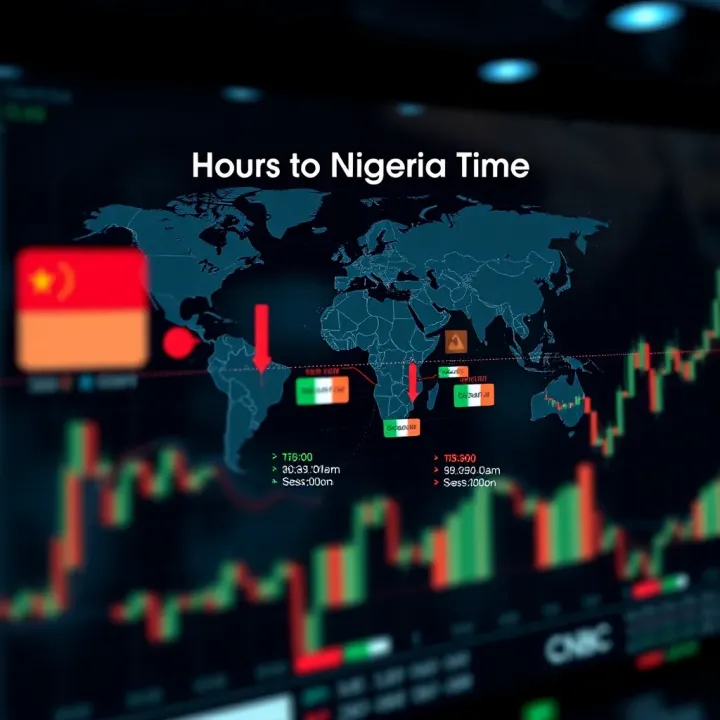
📈 Understand forex market hours tailored for Nigerian traders. Learn how local time affects trading sessions and when to trade for best results. 💹
Based on 5 reviews